Skip to content

PUBLICATIONS & BOOKS

Dr. Kostyantyn Rybachuk has published three groundbreaking works on education transformation, human potential development, and the neuroscience of learning. Each book builds on the last: from understanding how genius develops in the individual child, to understanding the systems that suppress it, to confronting the most urgent challenge of our time: what artificial intelligence is doing to the developing minds of children on a global scale. Together, the three books form a complete framework for anyone committed to unlocking, rather than suppressing, the genius in every child.

CODE OF GENIUS: How to Uncover Your Child's Innate Genius
Download Book Overview

PDF · English · 4.8 MB · Book overview and key chapter highlights

Buy on AmazonContact

CODE OF GENIUS:

How to Uncover Your Child's Innate Genius

This comprehensive guide reveals the neuroscience behind genius development and provides parents, educators, and caregivers with evidence-based information and tools to help identify, protect, and nurture innate genius in their children from birth through adulthood.

Core Concepts

The Three Critical Windows of Development (Ages 1-6, 6-16, 16-25)

The Neuroscience of Genius - Grounded in contemporary neuroscience research

Beyond IQ Tests: How to Truly Identify Genius Potential

Protection Strategies: How to Preserve Genius While Raising Resilient Children

Technology and Tools for Genius Unlocking

From Parent to Mentor-Educator

What You'll Gain

Deep understanding of how genius develops and why it's typically lost

Practical, immediately implementable strategies for recognizing genius in your child

Age-appropriate guidance from birth through young adulthood

Knowledge of critical windows and what to focus on in each

Understanding of neuroscience principles underlying all development

Vision of what your child could become with proper support

Actionable framework you can use immediately

Part Structure

PART I: THE REVOLUTIONARY DISCOVERY - THE CODE OF GENIUS DECODED

Chapter 1: 8 Billion Sleeping Geniuses

Chapter 2: The Evolutionary Paradox - Why Nature Hides Its Treasure

Chapter 3: Children Are Not Little Adults, but a Special Species Made for Discovery

PART II: THREE CRITICAL WINDOWS - TIME IS RUNNING OUT

Chapter 4: The Golden Window (1-6 Years) - 100% Potential Available

Chapter 5: The Silver Window (Ages 6-16) - 60-80% of Potential Can Be Saved

Chapter 6: The Bronze Window (Ages 16-25), Last 40%

PART III: TECHNOLOGY OF IDENTIFICATION AND DEVELOPMENT

Chapter 7: Diagnosing Genius - Finding a Needle in a Haystack

PART IV: THE ENEMIES OF GENIUS

Chapter 8: The Educational Paradox of China: Geniuses Under the Pressure of Exams

Chapter 9: The Educational Paradox of India: Coaching Instead of Education

Chapter 10: The Educational Paradox of the United States: Freedom versus Rankings

Chapter 11: The Educational Paradox of the European Union: Diversity of Systems and the Search for Balance

PART V: OVERCOMING OBSTACLES

Chapter 12: Enemies of Genius - Who and What Gets in the Way

PART VI: THE FUTURE OF HUMANITY

Chapter 13: From Homo Sapiens to Homo Genius

Chapter 14: Your Mission Starts Today

Chapter 15: Conclusions: The Final Warning

Key Takeaways

"Genius is not rare. It's suppressed."

"Every child has a genius potential. Your duty as a parent is to help your child unlock it and protect it."

Expert Reviews

ENDORSEMENT 1

As someone who has spent my entire career helping people learn, teach, and communicate more effectively, I found Dr. Rybachuk's CODE OF GENIUS especially powerful. I would have benefited from this insight when I was a new parent, and I know many parents today will too. This book reminds us that every child begins life with remarkable creative potential.

It is thoughtful, research-based, and genuinely eye-opening. I'm grateful Dr. Rybachuk wrote it, and I'm proud to recommend it to any parent who wants to help their child grow into the fullest version of themselves.

— Lawrence Sherman, FACEHP, FRSM, CHCP

President, Meducate Global, LLC

Tierra Verde, Florida, USA

ENDORSEMENT 2

This is a thought provoking and stimulating book, a must read for all parents. Dr. Rybachuk leaves us with a series of challenging suggestions about how we can allow our children's creativity to thrive. Drawing on research by NASA, he argues that if the right set of strategies are followed in the early years of their development, then their 'genius' potential can be unlocked. I found it a fascinating and enjoyable read.

— Dr. Peter Kent, OBE

Former President, International Confederation of Principals

Honorary Doctor of Letters, Warwick University, UK

ENDORSEMENT 3

This book is a Must-Read for Every Parent and Educator. In a world where academic pressure often overshadows individuality, this remarkable book offers a refreshing and science-backed perspective: Every child is born with a unique, innate form of genius.

Drawing from neuroscience, psychology, and modern educational insights, Dr. Rybachuk beautifully explains how the brain of a child is wired for creativity, curiosity, innovation, and limitless learning if we nurture it instead of restricting it.

Whether you are a parent, teacher, school leader, or education enthusiast, this book is not just worth reading; it is worth applying.

— Dr. Priyadarshi Nayak

Director Principal - St Xaviers High School

Founder and Chairman, Centre for Educational Development, India

Ideal Reader

Parents who want to understand their children's potential truly

Educators seeking to recognize genius beyond test scores

Family counselors and therapists

Anyone interested in child development and human potential

Parents concerned about losing their child's genius potential to pressure and systems

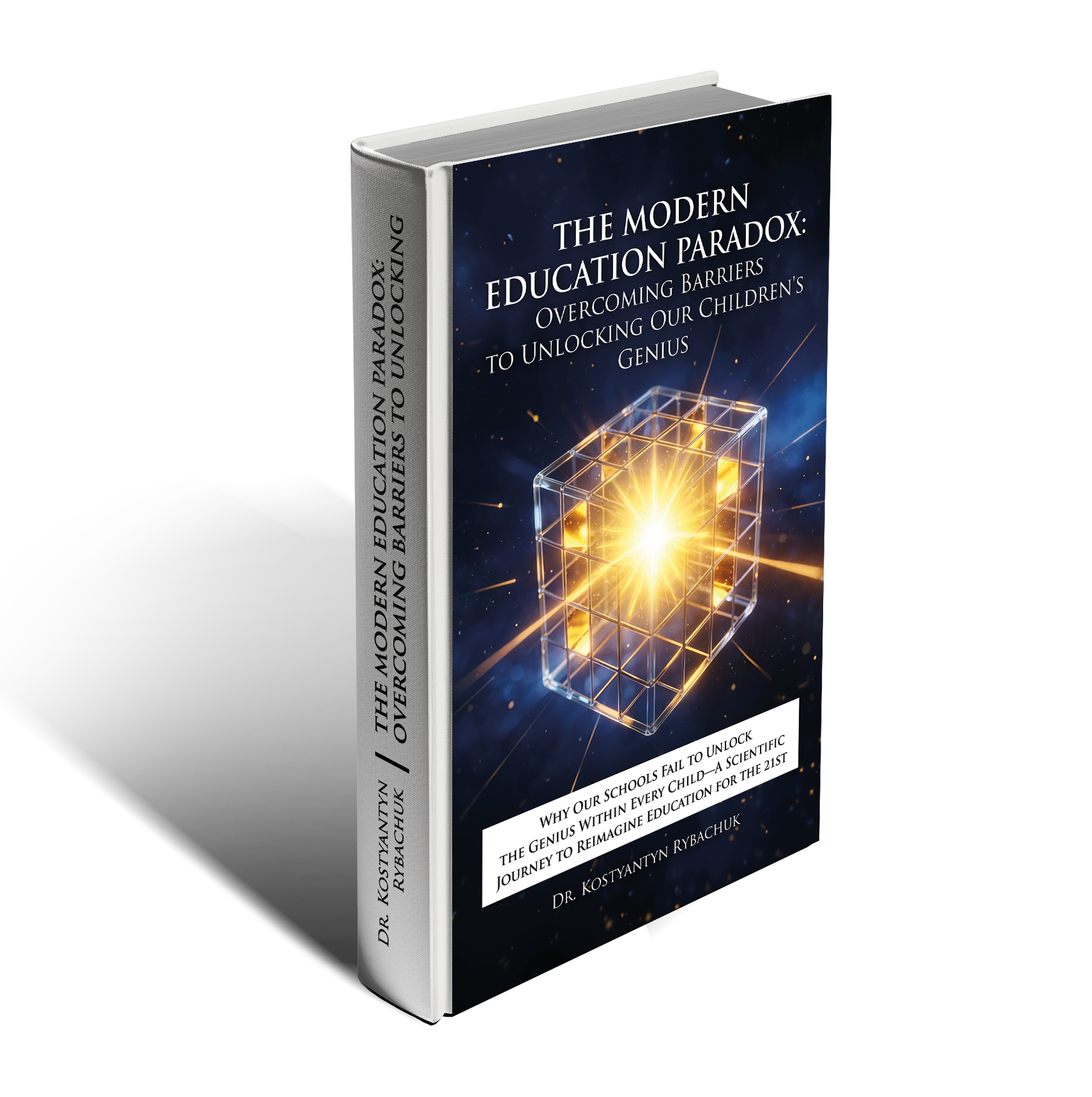
THE MODERN EDUCATION PARADOX: Overcoming Barriers to Unlocking Our Children's Genius
Download Book Overview

PDF · English · 6.0 MB · Book overview and systemic framework summary

Buy on AmazonContact

THE MODERN EDUCATION PARADOX:

Overcoming Barriers to Unlocking Our Children's Genius

This groundbreaking analysis examines why six major education systems (USA, China, EU, UK, India, Singapore), despite vastly different approaches, all fail to develop genius while simultaneously destroying student well-being.

Why do all these different systems produce similar failures?

This book reveals the answer, and more importantly, shows how transformation is possible.

Core Concepts

The Six Global Education Paradoxes

THE AMERICAN PARADOX: An Abundance of Resources and a Deficit of Genius

THE CHINESE PARADOX: Geniuses Under the Pressure of Exams

THE EUROPEAN PARADOX: A Diversity of Systems and the Suppression of Genius

THE BRITISH PARADOX: Cradle of Elites, Factory of Inequality

THE INDIAN PARADOX: Coaching Instead of Education

THE SINGAPORE PARADOX: A Triumph of Results and a Tragedy of Childhood

The Universal Pattern: Why All Different Systems Fail Similarly

Despite different philosophies, all systems:

Optimize for test performance, not thinking

Suppress divergent thinking

Treat equality as suppression rather than support

Measure what's easy rather than what matters

Burn out teachers

Create mental health crises even among successful students

The Universal Solution: Personalization + Genius Unlocking

What You'll Gain

Understanding of why global education systems are in crisis

Analysis of six different countries, showing common patterns

Evidence for why standardization fails everywhere

Understanding of costs (economic, social, psychological) of current systems

Vision of what transformation requires

Concrete, evidence-based strategies for systemic change

Policy recommendations grounded in research

Historical context and case studies

International perspective on your local challenges

Actionable framework for transformation

Understanding of how media myths suppress human potential globally

Knowledge of the planetary scale of genius suppression

Practical strategies to protect children from stereotype poison

Part Structure

INTRODUCTION

The Moral Purpose of Education in the 21st Century

CHAPTER 1: The Screen of Lies: How the Media Industry Turns Geniuses into Outcasts

Stereotypes about genius

Three key theses: the persistence of myths, systematic humiliation, the real victims

CHAPTERS 2-7: SIX GLOBAL EDUCATION PARADOXES

Chapter 2: The Educational Paradox of the United States

Chapter 3: The Educational Paradox of China

Chapter 4: The European Union's Education Paradox

Chapter 5: The Educational Paradox of England

Chapter 6: The Educational Paradox of India

Chapter 7: The Educational Paradox of Singapore

CHAPTER 8: Final Conclusions & Recommendations

From rhetoric to action

Neurobiological foundations of universal potential

Establishment of national platforms for genius development

Key Takeaways

"The paradox is not that different systems fail. The paradox is that we haven't noticed the pattern."

"Stereotypes about genius are not harmless. They are a form of social cancer with measurable neurobiological consequences."

"The 'mad genius' myth is one of the most damaging deceptions in human history. It has cost humanity billions in lost potential."

"Standardization works for mass production. It fails catastrophically for human development."

"Teachers are not the problem. Teacher suppression is the problem."

"Innovation and test scores are incompatible. You can have one or the other, but not both."

"The future leadership will belong to the first nation that systematically develops genius in all its children, and protects that genius from the poison of social stereotypes."

Expert Reviews

ENDORSEMENT 1

This book follows on from "Code of Genius: How to Uncover Your Child's Innate Genius," a book specifically for parents in the digital age.

This second book in the series, "The Modern Education Paradox: Overcoming Barriers to Unlocking Our Children's Genius," is more specifically written for the educationalist and educational leader and aimed at why we should and could develop methods to unlock greater potential in all learners.

The book is well-researched, and it's very clear to all who reads it that the author is very passionate about the subject. I would undoubtedly recommend this book to all involved in any life-skills and educational development.

— Professor Trevor Gibbs MD, SFHEA, DA. MMedSc, FRCGP.

Professor of Clinical Practice and Medical Education.

Past President, Association for Medical Education in Europe (AMEE)

ENDORSEMENT 2

This book offers a rigorous and well-researched analysis of education systems across different countries, placing policy, governance, and institutional frameworks at the center of the discussion. An essential read for anyone committed to strengthening education through global understanding and informed reform.

This work stands as a valuable reference for universities, policy planners, education departments, and scholars seeking to design resilient, inclusive, and forward-looking education systems.

— Dr. Priyadarshi Nayak

Director Principal of St Xaviers High School

Founder and Chairman, Centre for Educational Development, India

Ideal Reader

Government officials and policymakers

Education ministry leaders

School leaders and administrators

University professors, researchers, student future-teachers

Think tanks and policy organizations

Comparative education scholars

Anyone interested in systemic education reform

International education professionals

Parents who are concerned about the education systems

Media professionals and screenwriters

Anyone concerned about the suppression of human potential

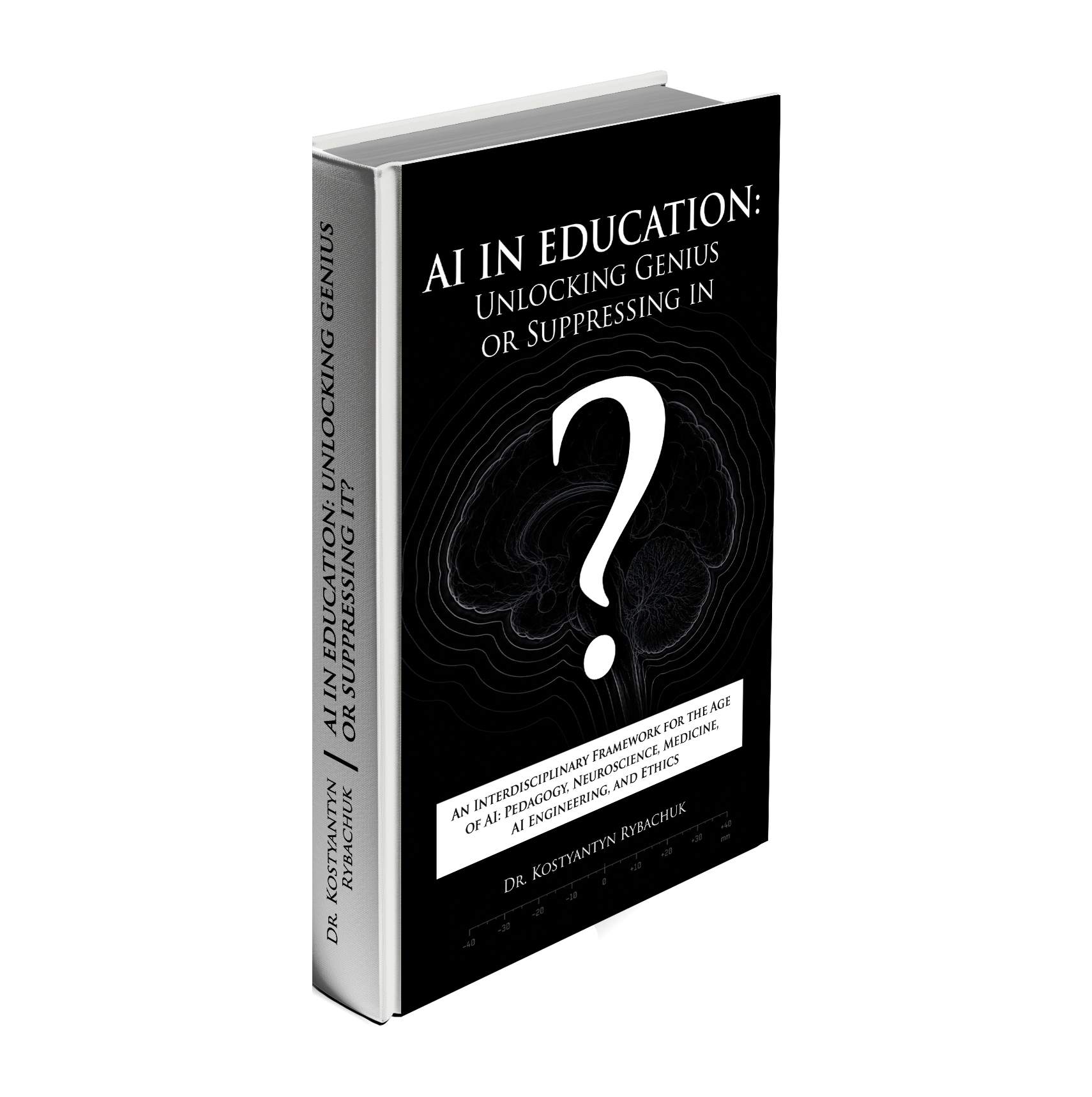
AI IN EDUCATION: Unlocking Genius or Suppressing It?
Contact

AI IN EDUCATION:

Unlocking Genius or Suppressing It?

In 2024, more than 450 million children were already using AI-based educational platforms every day. Not a single long-term neuroscientific study exists on what this is doing to their developing brains.

This book asks the question no one in the EdTech industry wants to answer: What if the most helpful feature of educational AI is the most harmful one?

It examines the evidence, names the mechanisms of harm, and provides a practical framework for evaluating, designing, and choosing AI systems that support rather than suppress the cognitive development of children.

Core Concepts

AI as a tool for personalization rather than automation alone

Neuroscience-informed learning pathways and cognitive safety

Pedagogy that keeps teachers, parents, and learners in the decision loop

Medical and ethical guardrails for high-stakes education technology

Engineering principles for systems that reveal potential instead of flattening it

What You'll Gain

A clear way to judge whether an AI tool develops or suppresses human potential

A cross-disciplinary framework for educators and institutions adopting AI

Practical questions for procurement, classroom use, and policy design

Language for balancing innovation, child development, privacy, and ethics

A bridge between the first two books and AI-era education transformation

Part Structure

PART I: THE AI INFLECTION POINT

Why education cannot treat AI as a shortcut or threat alone

How personalization can serve innate genius when designed responsibly

PART II: THE INTERDISCIPLINARY FRAMEWORK

Pedagogy, neuroscience, medicine, AI engineering, and ethics

Human oversight, learner agency, and developmental risk

PART III: FROM TOOL ADOPTION TO SYSTEM DESIGN

Evaluating AI platforms against human-potential outcomes

Building policies that protect children while expanding opportunity

Key Takeaways

"AI will not automatically unlock genius. Design, governance, and purpose decide the outcome."

"The goal is not to replace teachers, but to give every learner a more precise path to discovery."

"Education AI must be judged by what it protects, not only by what it automates."

Ideal Reader

Educators evaluating AI tools

School and university leaders building AI policies

Policymakers responsible for child-centered technology adoption

Parents asking how AI affects their child development and learning

Researchers and builders working across education, health, and AI

Which book is for you?

Three books. One framework. Choose your starting point based on your context and what you need most right now:

FOR PARENTS & FAMILIES

Start with: CODE OF GENIUS (the whole book)

Why: It is written for families who want to understand children's innate potential and take immediate action at home.

Then read THE MODERN EDUCATION PARADOX, especially Chapter 1: The Screen of Lies, to understand how myths affect child identity.

Then read AI IN EDUCATION to understand what AI tools are doing to your child's cognitive development and how to make informed decisions about the technology in their lives.

FOR TEACHERS & EDUCATORS

Start with: CODE OF GENIUS → Then read THE MODERN EDUCATION PARADOX

Why: First, understand individual genius development. Then examine the systemic pressures that make classroom implementation difficult.

Key chapters from CODE OF GENIUS: Chapter 2: The Neuroscience of Genius, Chapter 4: Beyond IQ Tests, and Chapter 7: Technology and Tools.

What you will be able to do: recognize genius in all students, counter stereotype threat in your classroom, advocate for school change, implement genius-recognizing tools, and understand and prevent your own burnout.

Also essential: AI IN EDUCATION. If you are using or considering AI tools in your classroom, this book provides a neuroscientific framework for evaluating them.

You will additionally be able to evaluate any AI tool against neuroscience-based criteria, understand which AI design features support genuine learning and which undermine it, and protect students in an AI-saturated environment.

FOR SCHOOL, UNIVERSITY LEADERS AND TEACHER EDUCATION PROGRAMMES

Start with: THE MODERN EDUCATION PARADOX, then CODE OF GENIUS

Why: First, understand the systemic context and opportunities for change, especially the planetary-scale problem exposed in Chapter 1. Then understand how to implement genius-focused approaches at your institution.

Focus on Chapter 1: The Screen of Lies, the Introduction and Chapters 2-7 for global context, and Chapter 8 for why now is a historical moment for change.

Critical addition: AI IN EDUCATION. Every leader making procurement decisions about educational AI needs this book because it provides measurable criteria beyond engagement metrics and test score performance.

This book is also essential reading for faculties of education and pedagogical universities preparing the next generation of teachers.

You will be able to apply the Cognitive Gap to evaluate AI platforms, make procurement decisions grounded in neuroscientific evidence, build institutional AI policy, and prepare future teachers with an evidence-based perspective on educational AI.

FOR POLICYMAKERS & GOVERNMENT OFFICIALS

Start with: THE MODERN EDUCATION PARADOX

Why: It frames the global crisis and gives policy readers the comparative view they need before making reform decisions.

Read Chapter 1 for the media and stereotype component of the crisis, Chapters 2-7 for deep analysis of education systems, and Chapter 8 for concrete policy recommendations.

Also read selected chapters of CODE OF GENIUS to understand individual development implications.

Essential addition: AI IN EDUCATION. This book makes the case for AI regulation in education equivalent to pharmaceutical regulation for children, with evidence base, framework, and policy vocabulary.

You will additionally understand the neuroscientific case for urgent regulatory intervention, design AI procurement and deployment frameworks grounded in developmental science, and articulate the stakes of inaction across political boundaries.

FOR RESEARCHERS & ACADEMICS

Start with: Read all three books as one framework

Why: Together they connect individual development, systemic education reform, and AI-era transformation.

Use the sequence CODE OF GENIUS first, THE MODERN EDUCATION PARADOX second, and AI IN EDUCATION third to move from child development to institutional systems to technology design.

The combined frame supports research across neuroscience, education policy, media studies, applied AI, medicine, and ethics.

Use the framework to test recommendations in your context, examine how stereotypes affect neural development and learning, and build shared language with international colleagues.

FOR AI DEVELOPERS & EDTECH TEAMS

Start with: AI IN EDUCATION

Why: This book is written partly for teams building educational AI. It presents the neuroscientific constraints within which genuinely beneficial educational AI is possible and gives four concrete design principles to implement.

Key sections: Part 2: The Four Disruption Mechanisms, Part 3: The Cognitive Gap, and Part 5: Four Design Principles for Productive-Failure-Preserving AI.

Then read CODE OF GENIUS to understand the brain you are designing for.

You will be able to understand the neurobiological consequences of design choices, evaluate your platform on measurable dimensions, implement design principles aligned with genuine learning, and build AI that serves children rather than metric dashboards.

FOR PARENTS CONCERNED ABOUT AI IN EDUCATION

Start with: AI IN EDUCATION

Why: If your child is using AI tutoring platforms, adaptive learning apps, or AI-assisted study tools, this book gives you the evidence and language to make informed decisions.

Then read CODE OF GENIUS to understand the genius potential you are protecting and how to nurture it at home.

You will be able to understand what AI features do to your child's developing brain, ask better questions about educational technology, set neuroscience-grounded boundaries, and advocate for school AI policies that protect development.

FOR MEDICAL AND HEALTH PROFESSIONALS

Start with: AI IN EDUCATION

Why: The neurobiological consequences of AI deployment during critical developmental windows are a medical and public health question.

Also read CODE OF GENIUS for the developmental framework underlying the argument.

You will be able to understand mechanisms through which instant-answer AI disrupts development, connect AI-mediated cognitive changes to developmental neuroscience, contribute to the conversation about AI as a public health issue in children, and advise families and institutions from an evidence-based position.